


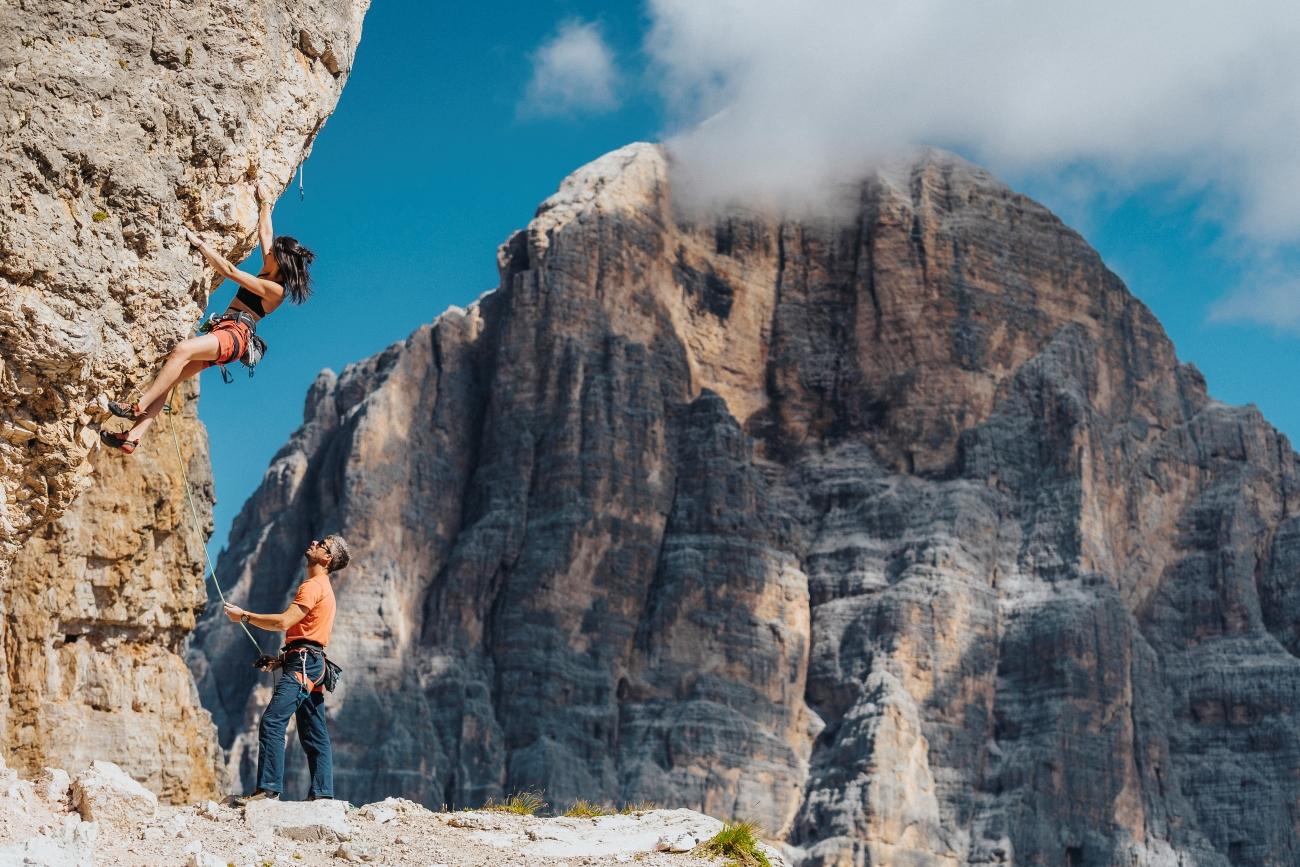

ROCK CLIMBING IN THE DOLOMITES – CORTINA D’AMPEZZO
Table of Contents
An introduction to some of the most iconic crags in the Ampezzo Valley of the Dolomites – plus some suggestions of how to spend your rest days.

The Dolomites are a mountain range in north-eastern Italy forming part of the southern limestone Alps. A popular holiday destination year-round, the Dolomites are best known for their stupendous landscapes and incredible sporting opportunities. In summer, you can hike, climb, mountain bike, road bike and paraglide; in winter the Dolomites become a skiing, mixed and ice-climbing paradise. All this takes place in a landscape filled with iconic peaks and quaint refugios where you can stop for a drink, coffee or delicious local meal.

You may already have heard of Cortina D’Ampezzo, a town located at the heart of the Dolomites, home to the 2026 Milano-Cortina Winter Olympics. What you may not know is that it’s one of the region’s epicentres for sport climbing, with almost 2,000 bolted single pitches to go alongside the more classic alpine routes.
Many of Cortina’s sport climbing crags are in pretty iconic locations (such as Cinque Torri), offer a good range of grades and climbing styles, and are very easily accessible with short walk-ins. While it’s true that some of the more classic routes may be a little polished, if you know where to look you’ll find a good number of freshly bolted sport crags frequented almost exclusively by locals.

SPORT CLIMBING IN THE DOLOMITES
CINQUE TORRI
Cinque Torri is a true symbol of the Dolomites. This collection of iconic mountain peaks (there are actually 11, not 5) are home not only to a number of classic alpine routes but also one of the most frequented sport climbing areas in the region. The crag used to be the place where the local climbing group, the Scoiattoli di Cortina, went to train in the 1940s, and the first routes were bolted as early as the 1970s.
Fast forward 50 years and you’ll now find over 200 bolted pitches from 3 to 8b in addition to the classic alpine routes on all sides of the Cinque Torri group. The rock changes considerably with the exposition, meaning that you’ll find both harder overhanging routes and more vertical, technical pitches full of pockets and jugs. It’s possible to climb here year round, but May to November are generally favourable if you prefer not to be too cold!
Approaches are relatively short (20 to 30 minutes long). It’s highly recommended you bring an 80m rope due to the pitch length and wear a helmet as the rock can be a bit loose.
BECO D’AJAL
Beco d’Ajal is a great crag for more advanced sport climbers looking for some solid overhangs to put their strength and stamina to the test. The crag is located in a dense fir forest North of Croda da Lago, with most of the routes concentrated on a large tower of smooth rock and the rest scattered across the surrounding smaller towers. At present, you can pick from around 50 different routes between 6a and 8c, offering vertical to overhanging climbing on crimps, pockets and the occasional jug.
Beco d’Ajal requires a 40 minute walk-in, making it one of Cortina’s more remote crags – but don’t let this put you off as the quality of the climbing and incredible views more than compensate for this! While the bolting is safe, do expect a few run outs.
The best season to visit is June to September.

CRÉPE DE OUCÈRA ALTE
Alongside Cinque Torri, Crépe de Oucèra Alte was one of Cortina’s first modern sport climbing crags to be developed. Today, you’ll find 80 routes from 6a to 8b+ concentrated in 4 different sectors across a cliff near the road to Passo Giau.
The style varies from sector to sector, but you’ll mostly find vertical to overhanging routes up to 40m long, requiring good endurance and excellent technique. As with Beco d’Ajal, be aware that the bolting can be a little spacy! The cliff is south-facing meaning you can climb from spring through to autumn, and you’ll also find some scenic multi-pitches in the area.
CRÉPE DE OUCÈRA BASSE
Crépe de Oucèra Basse is a pleasant north-facing crag located in the forest near Crépe de Oucèra Alte. Compared to some of the aforementioned areas, this crag is more suitable for beginner to intermediate climbers.
You’ll find 80 routes from 4 to 7c – including a lot in the 6th grade – that are safely and well bolted. The climbing is characterised by vertical pitches with holes and pockets, and perfect for the summer months since the crag is in the shade from midday.

VOLPÈRA, CAMPO AND SASSO DEI FINANZIERI
The Volpèra, Campo and Sasso dei Finanzieri crag is a diverse climbing area consisting of a series of large overhanging boulders in a dense forest. The routes are typically 15 to 20m long, span a range of grades, and require a combination of powerful, technical and athletic climbing that really puts all your skills to the test!
Advanced climbers looking for hard, overhanging routes should head to Sasso dei Finanzieri, while the Campo and Volpèra sectors boast some easier routes in addition to the harder classics.
RIO GERE
Rio Gere is a beautiful smaller crag located in the forest near a stream with the same name. This peaceful crag is home to 20 routes, 6a to 7c+ and up to 40m long, which offer amazing panoramic views over Mt Cristello. The routes are characterised by athletic, overhanging climbing and most suitable for intermediate to advanced climbers: the bolting can be a bit spacy and the majority sit around the 7th grade.


COLIFERE
Sasso di Colifere is another historic climbing area located very close to Cortina. As a result, it’s popular among local climbers for post-work sessions in the spring and summer months. You’ll find 15+ pumpy short routes, 6a to 7b, on mostly vertical to overhanging rock. The crag is east oriented, so get there in the mornings on cooler days.
CRODA DA LAGO
Croda da Lago is a medium-sized crag located at the foot of a rock group with the same name. At present, you’ll find two sectors situated quite close to one another offering a total of 30 pitches between 5b and 7b+, as well as some good alpine routes nearby. The crag is well worth a visit for the views out over Lake Fedora alone – just don’t forget that compulsory celebratory swim 🙂 That way, you really know you’ve earned your post-climb meal and beer at nearby Rifugio Croda da Lago.

PICCOLO LAGAZUÒI AND SASS DE STRIA
Located on the south face of a peak with the same name, Piccolo Lagazuòi is a small crag that was equipped in the early 2000s with the intention of creating a climbing area suitable for beginners. Since then, some harder routes up to 7b have been added – but you’ll still find a lot in the fifth grade. The routes are typically vertical to overhanging, boast nice views and catch the evening sun.
Sass de Stria is another small crag near Piccolo Lagazuoi designed with beginners in mind. You can find 30+ routes up to 25m long ranging from 4a to 6a.
DUKE
Finally, Duke is a nice crag for intermediate to advanced climbers located on a cliff near the Duc d’Aosta refuge. The crag was equipped between 2019 and 2020, meaning that the rock is unpolished and bolts well spaced. At present, you’ll find some quality single and multi-pitch climbs between 6a and 7c+, with pitches up to 40m long and incredible views of Conca Ampezza.

REST DAY ACTIVITIES
Active rest days are a must when it comes to the Dolomites – there are just too many incredible landscapes to explore!
Hiking in the Dolomites
Hiking is perhaps the easiest way to immerse yourself in the Dolomites’ beautiful natural environment. Numerous scenic trails and hikes of different distances depart from Cortina, perfect for challenging yourself on those days when your skin needs a break. The paths tend to be well marked and pass by numerous Refugios where you can stop for a coffee or lunch.
Mountain Biking in the Dolomites
Mountain biking is another popular rest-day option. However, unless you’re a pro who likes to suffer a lot, we highly recommend hiring an e-bike to make those uphills a little easier on the legs. You’ll find many bike rental shops in and around Cortina, and to make things even easier some cable carts and chair lifts are bike-accessible, allowing you to avoid the most aggressive uphills.

Some popular mountain and e-bike tours include:
- Lunga Via Delle Dolomiti – a nice introductory bike trail, perfect for beginners or families.
- Rifugio Biella – a beautiful trail for intermediate to advanced riders including some hard climbs and panoramic views.
- Fanes – 5 Refugi – A hard tour with some technical aspects and steep slopes, perfect for upper intermediate to advanced riders. You’ll be rewarded for your efforts by incredible views and the opportunity to stop at 5 quaint alpine refugios along the way.
- Pian de Loa – A beautiful tour through the woods with some good view spots, suitable for intermediate riders.
- Prato Piazza – A pleasant longer route through the Prato Piazza plateau, with several variations depending on experience.

Via Ferrata in the Dolomites
Translated as ‘iron roads’, via ferrata are climbing paths that follow the natural formation of the Dolomites’ peaks and are protected by iron cables and steps and ladders in the more technical sections. Despite the first via ferrata dating back to the nineteenth century, the majority of these were developed during the First World War when they were used to help get men and provisions into strategic places in the mountains. Today, they’re popular among outdoor enthusiasts because they allow you to summit many of the Dolomites peaks without needing much technical climbing knowledge or ability.
There are many different via Ferrata for you to choose from around Cortina and, as with the mountain biking, you can easily hire a Ferrata kit for the day from one of the town’s many outdoor shops. Anyone with previous climbing experience should have no issues, but bear in mind that some of the via Ferrata can be quite exposed and have difficult sections that someone newer to the sport might struggle with.

Dolomites Rock-Climbing Guidebook
The Guido Colombetti: Dolomites Crags guidebook published by Versante Sud is the best option for sport climbers. Published in 2021, this guide features 105 sport climbing crags throughout the Dolomites range, including those around Cortina D’Ampezzo.
If you’re looking to combine sport climbing, trad climbing, and via ferrata the Rockfax Dolomites Rock Climbs and Via Ferrata focusing on all three of these disciplines is a good option.
Logistics
Getting around
The Dolomites have a good public transport system by the standards of mountainous areas, but having your own car is definitely an advantage for getting you to some of the crags.
If you’re planning on hiking or exploring the area a bit more, we highly recommend purchasing a lift pass. The Ampezzo Valley’s extensive network of chairlifts and cable cars is extremely useful for getting you from A to B in a short space of time.

Guiding services
It’s possible to explore the Dolomites autonomously without the help of a guide, but in our opinion, a little local knowledge goes a long way. A local guide can help you discover some of the more off-the-beaten-track hikes, and bike tours, via Ferrata or climbing areas – knowledge which is incredibly valuable as the Dolomites become a more and more popular holiday destination. At the same time, they will help you develop your skills in your chosen sport.

- What you need to know before moving to New Brunswick
 What you need to know before moving to New Brunswick Canada New Brunswick is one of Canada’s three maritime provinces, and the only officially bilingual province in the country (recognising both English and French). Located on the Canada’s east coast, the province is often noted for its natural beauty, and rich culture. Like many other… Read more: What you need to know before moving to New Brunswick
 - 25 Most Beautiful Places in Japan
 25 Most Beautiful Places in Japan Japan is renowned for its delicate cherry blossoms and mesmerizing bamboo forests, but that’s only the beginning of the country’s charms. From the snowy wilderness of Hokkaido to the tropical forests of Okinawa, Japan has enough natural wonders to keep you in awe. Come explore some of the most stunning places… Read more: 25 Most Beautiful Places in Japan
 - 18 BEST THINGS TO DO IN KAUAI, HAWAII in 2024
 Kauai, Hawaii is an island for nature lovers. It’s breathtaking landscapes, from majestic mountains to ferocious volcanoes to stunning waterfalls and pristine beaches, the island is not short of visual feasts that please the eye. Kauai is the oldest of the Hawaiian Islands, and is also known as the “garden isle” because of its natural beauty. It’s… Read more: 18 BEST THINGS TO DO IN KAUAI, HAWAII in 2024
 - Celebrate Christmas in Canada’s Enchanting Destinations!
 Celebrate Christmas in Canada’s Enchanting Destinations!
 - The 5 best places to go dog sledding in Quebec – Canada
 The 5 best places to go dog sledding in Quebec #1- Aventures Plein Air St-Hippolyte, Laurentians Located on the shores of Lac Morency in the Laurentian region, Aventures Plein Air offers a full range of activities, in summer and winter alike. It’s the perfect place to go if you’re in Montreal and you’re looking for a… Read more: The 5 best places to go dog sledding in Quebec – Canada
 - Top 10 accessible cities in Europe for 2023
 Top 10 accessible cities in Europe for 2023 A Department of Transport study titled Disabled People’s Travel Behaviour and Attitudes to Travel found that “People with disabilities are more likely to report a greater number of difficulties with trips undertaken for different purposes, especially as the grade of disability increases”. The report states, “25 per… Read more: Top 10 accessible cities in Europe for 2023
 - Top 14 European cities which stand out for their beauty
 Top 14 European cities which stand out for their beauty With more than 800 to pick from, whittling down Europe’s most eye-catching cities is no easy task. Beauty may well be in the eyes of the beholder, but these 14 European cities all stand out for their picturesque architecture, history-stitched streets, and ridiculously photogenic settings.… Read more: Top 14 European cities which stand out for their beauty
 - 6 Unexpected Things to Do in Jordan
 6 Unexpected Things to Do in Jordan If you’re planning a trip to Jordan, it’s likely that a visit to the archaeological wonder and UNESCO World Heritage site of Petra is already on your itinerary. After crossing that must-see off your list, check out some of the many lesser-known activities worth experiencing in this Middle Eastern country. Here are six unexpected things… Read more: 6 Unexpected Things to Do in Jordan
 - Wadi Rum: Things to Do in Jordan
 Wadi Rum: Things to Do in Jordan “The Valley of the Moon”, depicted as Mars in several Hollywood feature films Wadi Rum is an Arabian fairy-tale waiting to be discovered. Home to nomadic Bedouin tribes, Wadi Rum is a quiet getaway of stars, sand, and sun; a perfect complement from Amman’s epicenter. Once inhabited by… Read more: Wadi Rum: Things to Do in Jordan
 - Best Things to Do in Jordan: Lost Cities & Ancient Treasures
 Best Things to Do in Jordan: Lost Cities & Ancient Treasures Think of things to do in Jordan, and the first image that comes to mind is usually the enigmatic lost city of Petra. Petra is truly magnificent, but it’s not the only jewel in this magnificent country – you’ll find plenty of amazing things… Read more: Best Things to Do in Jordan: Lost Cities & Ancient Treasures
